

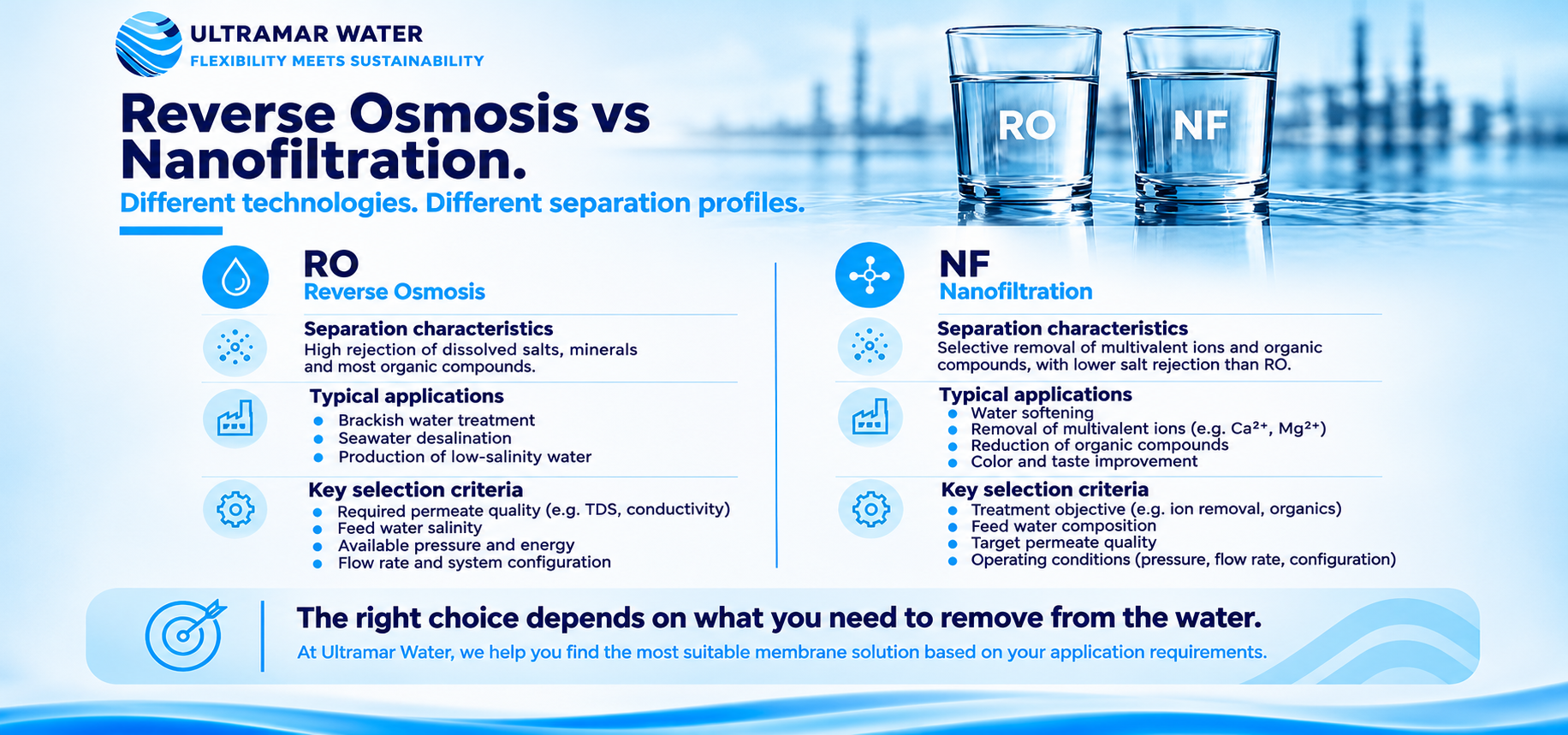
Reverse osmosis (RO) and nanofiltration (NF) are both membrane separation technologies, but they differ in their separation characteristics and the applications they are designed for.
Although both technologies are used in water treatment, they do not necessarily achieve the same separation results. Therefore, understanding the composition of the feed water and the required treatment objectives is essential before selecting a membrane.
Reverse Osmosis (RO)
RO is commonly used when a high level of dissolved salt removal is required. Typical applications include brackish water treatment, seawater desalination and the production of low-salinity water.
Reverse osmosis membranes are designed to reject a broad range of dissolved salts and other substances. As a result, RO is often considered when the treatment process requires a significant reduction in overall salinity.
Nanofiltration (NF)
NF offers a different separation profile.
Depending on the membrane characteristics and feed water composition, it can be used for the selective removal of certain multivalent ions and organic compounds.
Unlike RO, nanofiltration generally allows a greater proportion of monovalent ions to pass through the membrane, although the actual rejection depends on the membrane and operating conditions.
This selective separation can be useful in applications where complete salt removal is not the primary objective. For example, NF may be considered when the treatment process focuses on reducing water hardness or removing specific substances while retaining part of the dissolved mineral content.
How do you choose between RO and NF?
Start by defining:
- Feed water composition: which substances are present?
- Treatment objective: what needs to be removed?
- Target water quality: what must the permeate achieve?
- Operating requirements: what flow rate, pressure and system configuration are needed?
The choice of membrane technology should be based on the treatment objective and the specific application—not on the technology name alone.
While RO and NF share certain operating principles, their different separation characteristics make them suitable for different treatment requirements. Consequently, selecting the appropriate technology requires an evaluation of both the feed water and the desired results.
At Ultramar Water, understanding the application requirements is the starting point for evaluating suitable RO and NF membrane solutions.